Friday, June 27, 2014

BLOG HOPPING WITH FRIENDS

§

Just came from catching up on Heidi Greco's blog, Out on the Big Limb, which so reminds me of this one the way she introduces it: "Warning: this is one of those blogs that goes all over the place. Poems, politics, gripes, praise. A little of everything from an avowed generalist." I can relate.
Heidi Greco
reading at the Cascadia Poetry Festival 

I met Heidi at the Cascadia Poetry Festival in Seattle at the beginning of May. She tagged me in something called "Blog Hop" in which I get to answer some questions about my writing process and tag other writers who will do the same thing. 

Let me introduce Judy Dykstra-Brown, a writer I met in La Manzanilla last winter at the weekly ad hoc writing group that meets there every Saturday morning. 

A quill of writers enjoying the sunset (and the odd cool drink)
La Manzanilla, Mexico
During April Judy and I were both writing to prompts for National Poetry Month and posting the results to our blogs. The first prompt was to write an ekphrastic poem and I chose a picture of one of Judy's retablos to write on. She's prolific; she writes poetry, stories, articles and a blog in San Juan Cosala, Jalisco, Mexico.  Her books may be found on Amazon. She says when she's not writing, editing, posting or otherwise fussing over words, she likes to fuss over the 10,000 plus small objects that she shuffles around, arranges and attaches to form retablos and mixed media sculptures. She blogs at grieflessons.wordpress.com.

Jane Byers lives in Nelson, BC, with her wife and two children. She writes about human resilience in the context of raising children, sexism, lesbian and gay issues, local geography and the workplace.  She has had poems, essays and short fiction published in a variety of books and literary magazines in Canada, the U.S., and the U.K. including Grain, Rattle, Descant, The Antigonish Review and The Canadian Journal of Hockey Literature. This spring saw the launch of Jane's first poetry collection, Steeling Effects. (I blogged about it here.) We're in a wonderfully supportive poetry group together. 


Jane Byers
at the Nelson BC launch of Steeling Effects
Blog Hop is the brain child of Kristin Butcher, whose blog about this "writer's game of tag" may be found here. She's interested in how writers write, and to that end there are four questions I'm to answer. So, without further ado...


What am I working on?

Lately, I've been writing poems with no particular theme. In April, during National Poetry Month, I wrote to daily prompts, so the forms and subject matter are all over the place. Four of those poems were just accepted for publication in the New Orphic Review next spring. I'm looking forward to going to St. Peter's Abbey in Saskatchewan at the beginning of July for a week of focused writing. I want to start shaping my next manuscript. Other than that, I just published a chapbook for Stuart Ross through my micro press, Nose in Book Publishing, and I'm participating in the Columbia Basin Culture Tour this August so I'm busy producing handmade books these days. This fall I'm going to walk half the Camino de Santiago in Spain with my sister. I expect there will be some poems arising from that, even if they're only of the oh-my-god-my-feet-hurt-so-much variety. 


How does my work differ 
from others of its genre?

It's not published in book form yet! But I'm hoping that will change. My first full-length poetry manuscript just started making the rounds. How do the poems in it differ from others? Well, they're mine. Written in my voice, from my point of view, which means that even though other poets may have tackled the same subjects, what I see through my window is just a little different. 


Why do I write what I do?

Because writing about various issues and subjects allows me to explore them and because I get right cranky when I'm not getting stuff down on paper! I like telling stories in verse — the economy of words in poetry insists that you find the right ones. I enjoy the challenge of writing to form, but most often write free verse. Sometimes I write things I don't fully understand for months or even years. 


How does my writing practice work?

Mostly, I write poems by hand for at least the first draft, although sometimes I can compose one on the computer. I've already mentioned writing a poem a day during April. Because of time constraints I composed several of the April poems right here on my blog. (April, for me, began in La Manzanilla, then I was in Vancouver for a couple of days before coming home, then, at the end of the month, I was back to the Coast, as we Interior people refer to the Lower Mainland, and my last poems were written on Vancouver Island.) It feels very different, writing a poem by hand vs typing it. At the same time, I can't imagine writing prose by hand. I sporadically keep a journal and I write in it by hand, and pity anyone who ever has to read it because I barely can!  

I've participated in the August Postcard Poem exchange every year since 2007 and have been doing the 3:15 Experiment since 2005. 

I keep notebooks handy to jot down ideas for poems. Sometimes I even refer to them! I don't write every day, but I do try to carve out slices of uninterrupted — uninterruptible? — time for myself to concentrate on writing as often as I can. I read poetry every day.

 §

Sunday, June 15, 2014

TWO NEW BOOKS BY KOOTENAY AUTHORS VANGIE BERGUM AND SEAN ARTHUR JOYCE

§

Haven't posted for far too long. Put it down to: 
     a) taking a deep breath after April's daily poem extravaganza 
     b)  on book-making projects
     c) working on the garden
     d) on taking ever longer walks in preparation for doing half the 
         Camino this fall (yes; you read that right!)
     e) on my own writing

Notice what comes in last. Why is that?

In addition, I've been reading up a storm. As I mentioned in a previous post, I came home from the Cascadia Poetry Festival in Seattle with lots of reading material and I've been delving into that, very much enjoying the work of Marilyn Stablein, Joanne Arnott, Sharon Cumberland, George Stanley, Joanne Kyger, and Lyn Coffin.

Then there was a Nelson B.C. book launch with Vangie Bergum and Art Joyce, both books of creative non-fiction, both published by Hagios Press. I read a lot of poetry, so it was nice to sink into something different. I enjoyed reading both of them.

Vangie's book is Downstream: Bestemor and Me. I read the first few pages and was hooked. It's a braided story of a mysterious tragedy that happened in Bergum's family in the 1920s that, through the course of the book, she unravels, coupled with the story of how she trained to run the Great Wall of China marathon in 2008. It's a page-turner. Vangie Bergum really knows how to tell a story. 

Vangie Bergum reading from Downstream: Bestemor and Me

Art, who publishes under his full name, Sean Arthur Joyce, launched Laying the Children's Ghosts to Rest — Canada's Home Children in the West, an account of the history of the British children who were sent to Canada (and Australia) from 1869 into the 1960s to be placed with families, often on farms, often expected to work as labourers. 

While the subject matter decrees that this is not an easy book to read, I found it fascinating. Imagine children, some as young as four or five years old, being "rounded up" and put into care homes because their families had fallen on hard times and couldn't afford to look after them properly. Sometimes the parents turned the children over to these homes. Then imagine some of those children — more than 100,000 between 1869 and 1949 — being sent by ship to Canada where they were taken into homes and farms as labourers. Needless to say, it didn't always go well for these children. Nor, in fairness, did it always go badly, depending on where the children ended up. 

The author's grandfather was one of these "home children", and as is often the case when a child is traumatized, he never elaborated on his experience. Joyce was not aware of his past until, wondering what could have brought his grandfather to Canada by himself at age 16, he began looking into it in 2007.

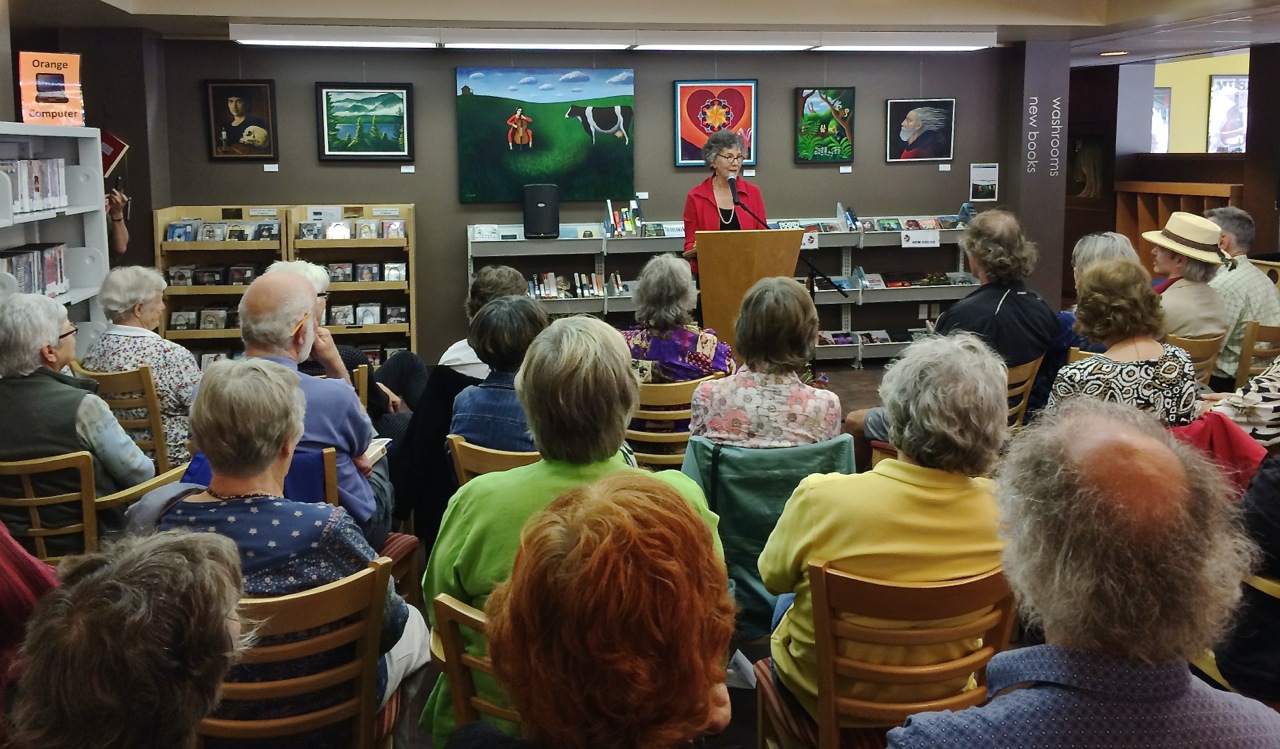
On the screen is a photograph of one of the Home Children's success stories: Leslie V Rogers, who eventually became principal of the Nelson High School. He was lucky enough to have been placed with a family that treated him as one of their own, which was not always the case. The present Nelson high school bears his name.

Both books include photographs which very much add to the telling of the stories.

§


Saturday, May 10, 2014

CASCADIA POETRY FESTIVAL ~ DAYS TWO, THREE, AND FOUR

§

I'm back in the Kootenays after an incredibly stimulating and satisfying weekend in Seattle at the 2nd Cascadia Poetry Festival.
It's been a full couple of days since I got home (thanks to a kitchen table discussion this morning with Ted and fellow Ootischenia poet, Kathryn Soloveoff-Robbie, I'm not going to use "busy" as an adjective to describe my life anymore, "full" being so much less pejorative). I still haven't put away all the suitcase stuff, but I've been reading, reading, reading, and this, in part, is why:


But let me back up a bit, to the morning after I arrived. I was staying a a very nice B&B situated about twenty blocks from where most of the festival was happening, namely the Spring Street Center and the nearby Pigott Auditorium at Seattle University. This meant that when the weather was good, I walked. I've taken to wearing a Fitbit pedometer and on the first, hot day I was there I managed over 22,000 steps! (Sadly, this is not anywhere near the case today as I've been trying to sort out pictures for this post!)
"Homecoming" by Tom Jay, 1999.
This was what I saw when I first left the house. There's a little park right beside it. I have a (so far) failed poem that talks about welcoming back the anadromous salmon to the Columbia. Seeing this was the perfect way to start the festival.


I walked to the Spring Street Center where
Paul E. Nelson was cooking breakfast for any takers.

Meanwhile, in the living room, Kim Goldberg took advantage of the lull before the storm to fold poems into lovely little booklets.

After breakfast Kim, David Fraser and I walked
downtown and took in the Underground Tour,
then went to Pike Place Market for lunch.

Chief Seattle

A totem pole
At Pike Place Market with David Fraser 
(photo © Kim Goldberg)
All righty, then!
It was a seafood lover's dream there.
One by one, poets began to appear. L-R: Paul Nelson, Kim Goldberg, Warren Dean Fulton, Joanne Arnott, David Fraser, and Gordon May.
I was delighted when Lowell Murphree dropped in.
We met virtually via the Modern and Contemporary
American Poetry MOOC (affectionately known as
ModPo) a couple of years ago, and he participates in
the August postcard exchange, too.
Audience, Thursday night Force Field and friends' reading (Jo Lilley and me being the friends). My pictures from that reading are in the previous post.(Photo © Kim Goldberg)

Friday morning there was a workshop led by three poets:
Joanne Kyger, George Bowering (both in the picture above),
and George Stanley.
George Stanley
Jean Baird talking about one of George Bowering's books 
Portland poet, Kaia Sand at Spring Street Center

Joanne Kyger, Paul Nelson, George Bowering, and Whitehorse poet, Joanna Lilley
Workshop participants. The ladies
are Meena Rose and Linda Russo.
The dynamic duo of Meredith and Paul Nelson with George. 
Friday, Saturday and Sunday afternoon from three till
five the Living Readings happened. We sat in a circle and
went around, reading an original poem (or filling the very important role of being enthusiastic audience). People loved it.
Nadine Maestas, Amalio Madueno, and Meena Rose
More of the Living Room reading

Lennee Reid laying it down at a Living Room session

Paul Nelson, Lyn Coffin, Gordon May, Ursula
Vaira, Yvonne Blomer and George Stanley

With Christian Fink-Jensen after the Living Room reading.
(Photo © Danika Dinsmore)

A little relaxation time at Spring Street Center
Gordon May, Lyn Coffin, Me, David 
Fraser, at Spring Street Center
(Photo © Kim Goldberg)
Paul and Ella, easily the youngest
participant and arguably the cutest!

Poets crowded around the Small Press Fair 
before the evening readings 

Portland poet, Emily Kendal Frey at the Friday keynote reading
Kaia Sand

Joanne Kyger 
George Stanley
George Bowering, reading from Teeth,
published by Mansfield Press

Gail Tremblay, from Olympia, Washington,
kicked off the Saturday night Force Field/Feminists (Allergic to Cats) readings 
MCs for the evening were Jocelyn MacDonald and Nadine Maestas, both of Seattle
Seattle poet, Shae Savoy
Kim Goldberg, who's from Nanaimo
Linda Russo, of Pullman, Washington
Alyse Knorr was here from Alaska, which is a
little outside of Cascadia, but we're good with that. 
 
Seattle poet, Jane Wong
Victoria poet, Yvonne Blomer, read from As If A Raven, just out from Palimpsest Press
It was an honour to read Yvonne's poem,
The Roll Call to the Ark, with her. 
(Photo © Christian Fink-Jensen)
Jeanne Heuving, from Seattle
Joanne Arnott sang to us! She's from Richmond, B.C.
Heidi Greco, from White Rock, B.C.
Emily Mundy, Seattle
Seattle poet, Sharon Cumberland, who was instrumental in getting the University of Seattle to be the venue for panels, major readings, and the Small Press Fair.
Marilyn Stablein, poet and book artist from Portland, Oregon
Danika Dinsmore, formerly of Seattle, and Christian Fink-Jensen, both from Vancouver, B.C. It was so good to meet Danika as she was one of the instigators of the 3:15 Experiment in poetry which looks at states of consciousness (or lack thereof; hence 3:15, as in 3:15a.m.!) in the writing of same. I've been doing August 3:15 poems since 2005.
Clearly, Paul didn't have enough to do this weekend. Here he 
is, collecting empty plates while Ella looks on approvingly. 
 
Saturday morning David McCloskey, founder of the
Cascadia Institute, aka "the father of Cascadia" gave
a talk about the geography and ecology of the region 

and unveiled a new map of the area.
There was also a slide show with some pretty cool pictures, like this one. The net that fish is in is bigger than the man holding it!
Cascadia is the green area 
Map of the bio-region.
Next, the panel Cascadian Poetics: Innovations from Here, with Stephen Collis, Jeanne Heuving, George Stanley
and Joanne Kyger.
Joanne Kyger
George Stanley
George and Joanne go way back, to San Francisco in the 
late 50s and the Magic Workshop days of Jack Spicer 
and Robert Duncan.
Jeanne Heuving
Stephen Collis
At the panel
Paul Nelson reading USAmerica.
You can hear him reading it here!
Danika Dinsmore at one of the after party readings. I only made
it to this one. Pleading exhaustion (plus that long walk home!)
Dennis E. Bolen
Judith Roche

Raanan, who was everywhere with that camera
Sarah Brickman
Larry Crist
Not these two again!
Sunday morning's first panel was Discussion on Landscapes/Actions/Embodiments, moderated by
Linda Russo, with Joanne Arnott, Joanna Lilley,
Eleni Stecopoulos (from Berkeley, CA) and Marilyn Stablein.
Marilyn presented a video of a performance piece called "Intrusions in Ice: Building the Ice Wheel" that included a dancer and herself arranging blocks of ice into a 3-D wheel that she produced for Bumbershoot in 1990.
After the panel Marilyn slipped out and reclaimed her table
at the Small Press Fair. Her books are beautiful.
Thomas Walton and able assistant at the Small Press Fair.
His Pageboy litmag is just gorgeous
Meredith and Paul. Go, team!
Maged Zaher, Seattle
Stephen Collis, Vancouver, B.C.
Heather McHugh coming up to read
Frances McCue
Heather McHugh and Frances McCue, both of Seattle and both amazing!
No poetry festival is complete without an after party.
This one included some very delicious saki!
Cathy Visser, her husband Joe Chiveney, and Nadine Maestas.
Joe and Cathy were largely responsible for the delicious meals that kept appearing. There was this pumpkin soup...
Poets mid-mingle
Suzy Wong Scollon, with Joanne Arnott 
and Gordon May.
Kim Goldberg deep in conversation with Larry Crist

Paul, Joanne, Joanna and Stephen
Paul enjoying a chat and a well-deserved glass of saki. 

For some other takes on the Festival, check out these reports:

Paul E. Nelson, whose poetic vision has allowed both Cascadia I and II to happen, blogs about this year's fest here

Kim Goldberg's take on it is here

Heidi Greco's is here.

Joanne Arnott's is here, and as an added bonus, she very kindly blogged about my Rodeo Nights chapbook here!

As I mentioned up there somewhere, I didn't make it to all the really late events, including the Beer Slam which I understand was great. Robert Lashley won that. 

I'll come back and add more as I find them. Meanwhile, you should  know that Cascadia III will be held in Nanaimo next year, April 30 – May 3, 2015. It's on my calendar already. How about you?

§